The Table That Becomes a Stage: Making Things in a Small Flat With Thin Walls
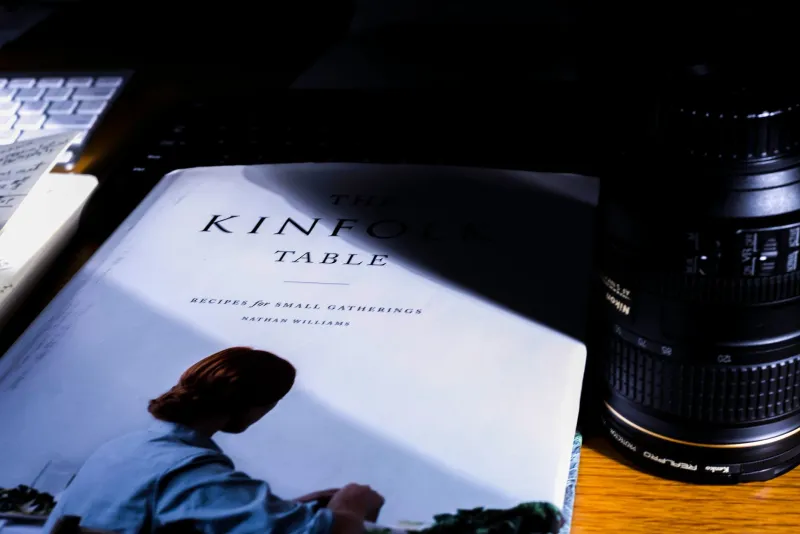
There is a particular sound a kitchen table makes when you clear it in a hurry. Not a bang — more a soft percussion of cutlery, a mug ring left behind, the creak of a chair pushed back. For years that sound meant the end of something. Now it means the start.
I don't have a studio. I have a table that seats two comfortably and four if we all breathe in. It's pine, it's slightly scarred from a candle that got away from me one December, and in recent years it has been a desk, a drying rack, a sewing table, a photography set and, on one memorable evening, a stage.
The flat has opinions
Our flat isn't a container for the work. It's a collaborator with strong views. The neighbours are in by half six, so anything percussive happens before then. The light is best between ten and twelve, which means the ambitious ideas get the morning and the admin gets the afternoon. The wall behind the table is a pale sort of green I chose in a hurry and have grown oddly fond of — and it turns out to be exactly the right colour behind a sketchbook page when I photograph it for the newsletter.
You learn to work with what the building gives you. I've stopped mourning the studio I don't have and started treating the flat as a set of conditions to design around, the same way you'd design around a low ceiling or a narrow staircase.
What the constraints actually give you
People assume making work at home is a compromise. Some days it is — the hoovering wins, the table disappears under post, someone rings the doorbell just as something clicks. But constraint isn't the enemy of the work. Very often it's the thing that gives the work a shape.
Because everything has to be packed away by six, I finish things. Because I can't leave a project spread across three surfaces for a fortnight, I make decisions earlier than I otherwise would. Because the table has to be a table again by teatime, I've become ruthless about what earns a place on it.
There's a lovely honesty to it as well. Nothing in this flat is precious. If a piece of work can survive being moved twice a day, sat next to a bowl of satsumas and occasionally splashed with tea, it's probably robust enough to go out into the world.
Three rituals that earn their keep
I'm suspicious of routines that need perfect conditions, because perfect conditions are in short supply round here. These three survive contact with real life.
The five-minute clear. Before anything else, I clear the table completely — not tidy, clear. Everything off. Then I put back only the three things I need. It takes less time than making a cup of tea and it signals to my brain that the room has changed jobs.
The closing line. At the end of a session I write one sentence in a notebook: what happens next. Not a to-do list, just the single next action. It means tomorrow doesn't begin with a blank page and a small wave of dread.
The wrong-chair trick. When I'm stuck, I sit in the other chair — the one facing the window — and look at the work from there. Half the time the problem is obvious within a minute. It's a very cheap way of getting a second opinion from yourself.
Prompts for anyone making things at the kitchen table
Take these or leave them. They're nudges, not rules.
- Name the constraint out loud. Write it down: the table goes away at six, the neighbours are in at half six, the good light is in the morning. Then ask what the work would look like if you designed for that instead of against it.
- Make one thing that fits in a shoebox. Small isn't lesser. Small is finishable, and finished work teaches you more than a beautiful unfinished thing ever will.
- Photograph the mess before you clear it. It's evidence, and it's strangely encouraging three months later when you've forgotten how much you actually did.
- Give the table a job title for the day. Tuesday is a writing desk. Wednesday is a workshop. It sounds daft. It works.
- Keep a scrap of paper by the kettle for the ideas that arrive when your hands are wet. They're always the good ones and they never come back.
Your turn
I'd like to hear about your kitchen-table projects. The half-finished thing under the ironing board. The song written at half eleven with the telly on mute. The zine assembled between school runs. The small business that started life as a spreadsheet next to a plate of toast. I'm genuinely nosy about all of it.
Send me a line — a photo, a paragraph, or a single sentence about what you're making and what your table has to be by six o'clock — and I'll gather the best of them into a mailbag piece later in the year. Consider this an open invitation, no matter how small, strange or stubbornly unfinished the project is. The table is a stage. Show me what's on yours.