Charity Shop Sets and Borrowed Laptops: Making a Show for the Price of a Takeaway
I once made a show for £50. Not as a brag, and not as a stunt — it was simply the number in my bank account that month that wasn't already spoken for by rent, and I'd decided the show was happening regardless.
It was in a church hall with a floor that sloped in a way nobody had warned me about, and I spent the first hour of get-in taping a cable down while a man from the kitchen committee watched me with deep suspicion. And it worked. People came. Some of them cried. One of them asked, afterwards, who had done the design.
So: here's what I learned, written down properly, because I keep meeting people who think the answer to a small budget is a bigger budget.
Decide what the audience has to believe
Before you buy a single thing, sit down and make two lists. The first is: what must the audience believe for this to work? A door is a door. Rain is rain. That's it. The second list is: what would actively distract them? A wobbling flat. A costume that looks like it came from a dressing-up box rather than a wardrobe.
Everything not on either list is decoration, and decoration is where tiny budgets go to die. I once spent £22 of a £60 budget on fairy lights because I'd convinced myself the room needed 'warmth'. The room needed a working light switch, which it turned out not to have.
The charity shop rules
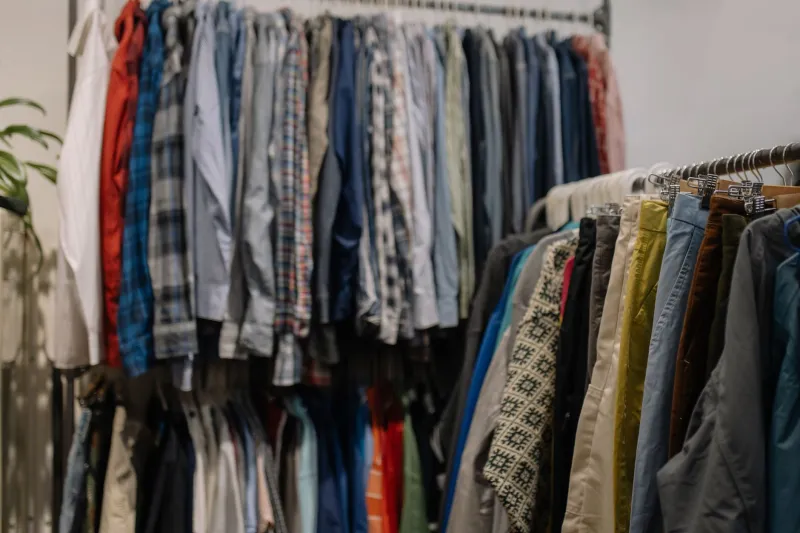
Go with a list, not a mood. Three shops, one afternoon, and a hard rule that you don't buy the first thing that half-fits the brief — the second shop always has something better and cheaper, that's just physics.
Look for silhouette and texture rather than accuracy. From the fourth row back, a 1980s blouse reads as period even if the buttons are wrong, and a heavy curtain reads as wealth. Nobody in the audience is examining your hems, because they can't see your hems.
And ask about the unsold stock. Plenty of shops (British Heart Foundation, Oxfam, your local hospice shop) will sell a bag of textiles that won't make it to the rail for very little. Fabric is fabric. Fabric is also a backdrop, a flag, a shroud, and a decent hat.
Borrow, don't buy
This is the single biggest lever and it costs nothing but nerve. Freecycle and Nextdoor are full of people desperate for someone to take a folding table off their hands. Facebook Marketplace has a 'free to collect' filter that has furnished at least two of my shows. Local amateur dramatics societies have store cupboards that would make a fringe venue weep with envy, and they're usually delighted to be asked.
Write a borrowing sheet. Who lent what, when it goes back, what condition it was in. Then return everything clean, on time, and with a thank-you note. Your reputation is the cheapest material you will ever own, and it's the only one that appreciates.
The tech is free now, mostly
The genuinely astonishing thing about making work in 2026 is how little the software costs. DaVinci Resolve for editing, Audacity for sound, OBS for anything screen-shaped, Canva's free tier for a poster that doesn't look like a poster, Google Sheets for everything you'd otherwise pay for.
For playback, QLab's free version handles a surprising amount. Ticketing can be a free tier on Ticket Tailor, or — and I mean this sincerely — a Google Form and a cash tin with a named person guarding it.
Lighting: hardware shop work lights, a dimmer, and gels from the offcut bin at a theatre supplier. Sound: one good borrowed speaker, one backup cable, and then a second backup cable, because the cable is always the thing that fails at 7.55pm.
Ask venues for the night nobody wants
Tuesday. Wednesday. The dead week in January. Community centres, church halls, the upstairs room of a pub that only uses it for quiz night, libraries, record shops, the back of a hairdresser's. Ask what their quietest night is, and then ask what would make that night worth their while — a paying bar, a tidy-up rota, a room full of people who might come back.
Do the boring admin. Public liability insurance. Fire exits. Who holds the key. Whether they need a licence for anything, and what the PRS situation is. I know it's dull. It's also the difference between a one-off favour and a venue that books you again.
The actual £50
- £12 — textiles and two garments from charity shops
- £9 — hardware shop work light and bulbs
- £6 — gaffer tape, the true currency of the arts
- £8 — printing at the library
- £10 — props from a Sunday car boot
- £5 — biscuits, non-negotiable
That leaves nothing for contingency, which is why half the show was borrowed. The £50 is a discipline, not a moral position. It forces decisions early, and it means you stop waiting for permission to make the thing.
What I don't scrimp on
Insurance. A fire plan. Someone on the door who actually knows the building. Water and tea for the company. And, wherever humanly possible, paying the people on stage — which is a whole other conversation, and one I'll be having on here soon enough.
A sloped floor, a borrowed speaker, and a room that smells faintly of soup. That was the show. It cost less than a takeaway for four, and people are still talking about it.