Propped Against a Mug: What Filming My Hands Taught Me About Honest Process Clips
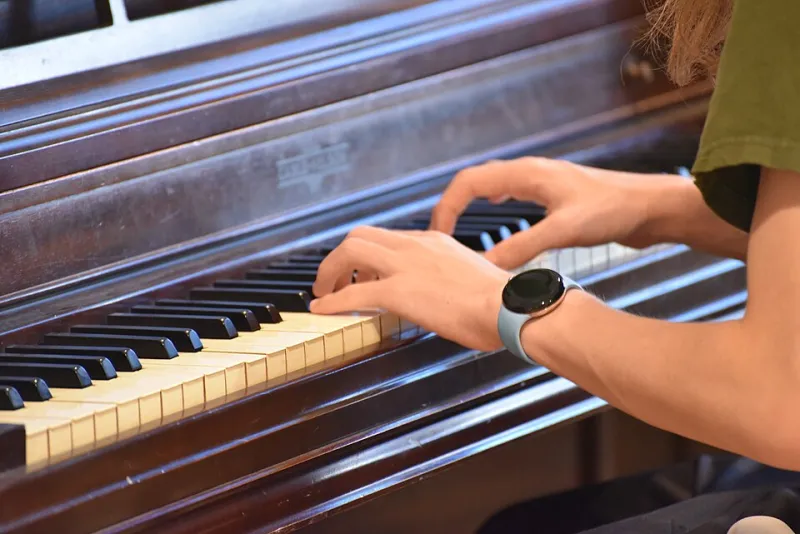
Photo: Candeadly, CC BY 4.0, via Wikimedia Commons
Last Tuesday, in that flat silvery light November does so well, I did something I had been avoiding for roughly three years. I propped my phone against a mug on the windowsill, pressed record, and filmed my hands for two minutes while I worked. No ring light. No script. No jaunty caption. Just me, a heap of paper, a glue stick and the sound of next door's extractor fan.
I expected to hate it. I expected to watch it back and see every reason why I am not a 'video person'. What I actually saw was closer to the truth of the work than any polished clip I have ever paid someone else to make. It changed how I think about showing process online.
The footage that surprised me
The first thing I noticed was how much my hands give away. They hover. They change their mind. One thumb presses a fold flat, then lifts it again because the edge is not quite square. I had filmed thinking I was capturing a neat little task, and instead I captured a series of small arguments with myself. That, it turns out, is the interesting bit.
When I posted a twenty-second slice of my hands re-sticking a corner I had already stuck down, someone left a comment: 'I did not realise you had to decide that.' That single line taught me more about artist videos than any advice about lighting or hashtags. The decision was the content. Not the finished thing, not my smiling face, not the confident summary at the end. The wobble.
Why hands are more honest than a script
There is a particular kind of video that begins with a person telling you how passionate they are. I have made several of those. They are perfectly pleasant and entirely forgettable. Hands, by contrast, cannot really perform enthusiasm. They just get on with it, and in doing so they reveal the pace of the work, the tools, the bits that need two attempts.
Filming my hands also solved a quieter problem. I am not a natural in front of a camera. I talk too fast, or I go stiff and sound like I am reading a meter. Hands gave me somewhere else to put the attention. If you are shy, or if you simply find the sight of your own face on a screen mildly exhausting, this is a route in. The viewer is not watching you; they are watching the work, and you happen to be the one doing it.
What I leave out, deliberately
A two-minute clip is not a shorter version of a sales pitch. It is a different thing altogether, and that means cutting some things I used to think were compulsory.
- The introduction. Nobody needs me to explain who I am before they have seen anything. Let the work arrive first and let a single line on screen do the introductions later.
- The music that tells people how to feel. A slow piano says 'this is meaningful' before the viewer has decided for themselves. Room tone, or near silence, is braver and usually better.
- The speed-up. A frantic timelapse smooths out the very pauses that make the process legible. Keep one pause intact. It reads as thought, not dead air.
- The tidy desk. I film the real table. If there is a mug ring and a pair of scissors that do not belong to this job, so be it. Cleaning up for the camera makes the camera feel like a visitor.
- The closing plea. One quiet line at the end is plenty. The clip is a postcard, not a leaflet through the door.
A two-minute shape you can try this week
You need a phone, a window, something to prop it against, and a task that takes longer than two minutes. That is the whole kit list. Here is the shape I have been using.
0:00 to 0:10 — Place. Let the room be in it. A hand enters the frame and sets something down. No talking. This is the equivalent of opening a door for someone.
0:10 to 0:35 — Set-up. Arrange the tools. Lay out the materials. Keep it ordinary. If you are nervous, this is where you settle, because you are just doing what you would do anyway.
0:35 to 1:30 — The decision. This is the heart of it. Choose the moment where you compare two options, correct a mistake, or pause to work something out. Do not cut the pause entirely. That little gap is the bit people will remember.
1:30 to 1:55 — The small finish. Not the masterpiece. One element resolved. A corner turned, a line drawn, a piece set in place. Something the viewer can see close.
1:55 to 2:00 — The hand-off. One line, on screen or spoken, saying what this is and where to find more. Quiet. No drumroll.
The windowsill rules
Put the light to the side of your hands, not behind them. Wipe the lens with a tea towel; it makes more difference than any filter. Switch the phone to airplane mode so it does not buzz halfway through. Lock the exposure by pressing and holding on the screen. Film six minutes and keep two, rather than filming forty and dreading the edit. And if the radio is on in the next room, either turn it off or accept it as part of the texture. I have started to like the texture.
The invitation, not the pitch
The thing I keep coming back to is that a good process clip does not ask the viewer to buy anything. It asks them to notice something. It gives them a vote on the decision you were wrestling with, and once someone has an opinion, they are involved. That is a far better place to start a relationship than a slogan.
The phone is still propped against the mug, incidentally. I have not moved it. It seems to have become part of the studio now, somewhere between the scissors and the second-best glue stick, waiting for the light to be right.