Fairy Lights, Frozen Fingers and a Queue for Chips: What a Village Switch-On Taught Me About Holding a Crowd
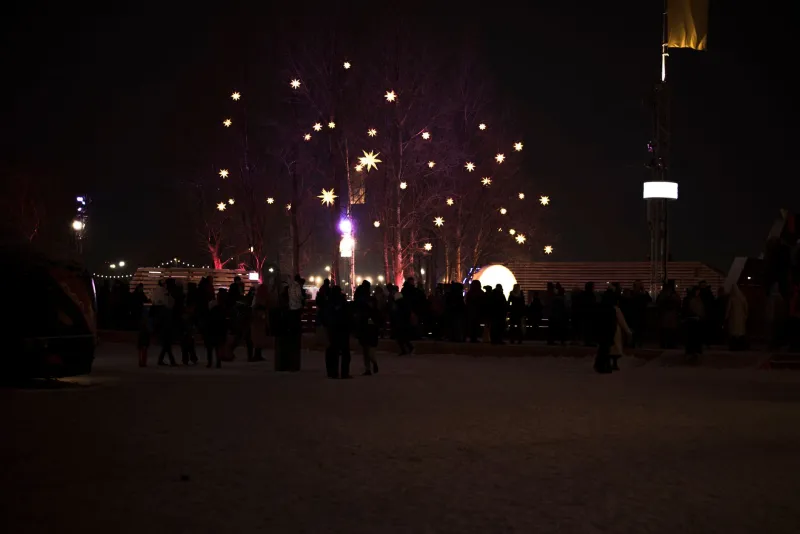
There is a particular sound a village Christmas lights switch-on makes. It is not applause. It is the low murmur of people asking whether the chip van has arrived yet, the crackle of a PA system that has been stored in a shed since October, and a child somewhere near the memorial bench announcing, with great authority, that Father Christmas is late.
I said yes to this gig in the way I say yes to most things in November: slightly too quickly, with a mug in one hand and a diary in the other. It was not a ticketed event. There was no box office, no green room, no rider requesting still water and a bowl of crisps. There was a gazebo, a donated generator, a string of fairy lights that may or may not have been PAT tested, and a crowd that had come out for the switch-on, the raffle and the possibility of chips. I was the bit in between.
And honestly? It was one of the most useful performances of my year.
Nobody Bought a Ticket, and That Changes Everything
When people have paid, there is a contract. They sit down. They shush each other. They expect to be taken somewhere. When people have wandered out of their houses in coats and wellies because the lights are going on at six, there is no contract at all. You are not competing with another show. You are competing with a queue, a puddle, a lost glove and the rumour that the chip van is doing battered sausages.
My first instinct was to treat it like a normal set. Begin at the beginning, build gently, earn the attention. That lasted about ninety seconds. The wind took the first line of my opening and delivered it somewhere near the recycling bins. A toddler had a small meltdown by the tombola. Two teenagers were filming each other with the lights behind them. Half the audience was facing the wrong way because the chip van had just switched on its serving hatch light.
So I stopped building and started joining in. I asked how many people had come out mainly for the chips. A surprising number put their hands up. I said that was fair enough, and meant it. The mood shifted. Not into rapt attention, exactly, but into something better: permission. We were all standing in the cold together, and nobody had to pretend this was the Royal Albert Hall.
Make It Short, Make It Repeatable, Make It Warm
Outdoor crowds are not rude. They are distracted. There is a difference, and it is worth remembering when you are three minutes into a piece and a dog starts barking at a runaway balloon. The work has to be built for interruption.
I cut everything that needed silence to land. I kept the bits that could survive a gust of wind, a child asking loudly where the toilet was, or the sudden roar that goes up when the lights finally come on. I repeated the key idea three times in three different ways, because repetition is not insulting in a field. It is a courtesy. People arrive halfway through. They leave to find their friend. They come back with a paper cup of something hot.
I also learned to use the space rather than fight it. Instead of standing behind a trestle table, I moved to the edge of the gazebo and spoke to the front row directly, then turned and included the people at the back who were mostly watching the chip van. I gave them a job: tell me when the chips arrive. They did. It became a running joke. It also gave me a way to check the temperature of the crowd without asking, “Are you all right?” in the tone of a children’s entertainer who has lost control.
Weather Is Not a Technical Hitch
I have done enough outdoor work to know that rain is not an emergency. It is a design condition. On this particular evening it was not rain but cold — the sort that gets into your fingers and makes you fumble with props. I had planned a section with a small handheld light and a folded paper star. In the warm studio, it was charming. On the green, with frozen hands and a wind that kept snatching the star, it was a faff.
Next time I will have a cold-weather version of everything. Gloves with the fingertips cut off. A script printed large and clipped to a board, because paper flaps. A set of moves that do not require fine motor skills after six o’clock. And a shorter running time than I think I need. Twenty minutes in a warm room is generous. Twenty minutes in a cold field is an endurance event. Fifteen is kinder. Twelve is often enough.
The Scrappy Gigs Are Worth Saying Yes To
There is no glamour in a village switch-on. Nobody is going to review it. The photos will be blurry and someone will have their eyes closed. You will drive home with wet shoes and a strange smell of generator fumes in your coat. But these are the gigs where you find out what your work is actually made of.
A ticketed audience has already agreed to meet you halfway. A village green has not. If you can hold a few people’s attention while they are waiting for chips, you have learned something real about clarity, warmth and pace. You have learned how to be a human being in a crowd rather than a performer behind a fourth wall. You have learned that “thank you for standing in the cold” is not a throwaway line. It is the whole point.
And when the lights came on, I stopped talking. Everyone cheered. The chip van opened. A woman in a Santa hat told me she had no idea what my piece was about but she had enjoyed the bit with the star. I will take that. In 2026, with another winter of small, strange, civic gigs ahead, I will take that every time.